
Seventy year weeks of Daniel
Daniel 9:24-27 is a key biblical passage. It is the only Old Testament passage which refers to the Messiah as “Messiah” (verses 26-27, in KJV). Elsewhere He is called “Shiloh” (Genesis 49:10), the “Root of Jesse” (Isaiah 11:10), the “Righteous Branch” (Jeremiah 23:5), the “Prince of Peace” (Isaiah 9:6), etc. But the name by which He is known best, “Messiah,” appears in only one passage: Daniel 9:24-27. Here is an excerpt from that passage: "Seventy sevens have been decreed for your people. . . . So you are to know and discern that from the issuing of a decree to restore and rebuild Jerusalem until Messiah the Prince there will be seven sevens and sixty-two sevens; it will be built again, with plaza and moat, even in times of distress. Then after the sixty-two sevens the Messiah will be cut off and have nothing, and the people of the prince who is to come will destroy the city and the sanctuary.” So, between the beginning and the end, there are 7+62=69 year-weeks or 7x7 + 62x7 = 49 + 434 = 483 years (in the system of 360 days per year).
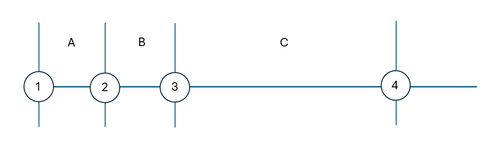
Point 1 is the date that Daniel received the 70-yearweek-prophecy. Do we know the year? No, not exactly, but some time in the 6th century BC.
Point 2 is the date of the beginning of the 70 yearweek-period. Do we know the year? Yes, because we know the date of point 3 and we know period B.
Point 3 is the year that the decree was given to rebuild Jerusalem, 445 BC. And period B was 7 yearweeks or 49 years in length. So point 2 must have been 445 + 49 = 494 BC.
Point 4 is the glorious entry of Jesus (Messiah the Prince) on Palm Sunday in the year 30 AD, counting that the corrected birth of Jesus was around 3 BC.
Point 2 is the date of the beginning of the 70 yearweek-period. Do we know the year? Yes, because we know the date of point 3 and we know period B.
Point 3 is the year that the decree was given to rebuild Jerusalem, 445 BC. And period B was 7 yearweeks or 49 years in length. So point 2 must have been 445 + 49 = 494 BC.
Point 4 is the glorious entry of Jesus (Messiah the Prince) on Palm Sunday in the year 30 AD, counting that the corrected birth of Jesus was around 3 BC.
What is exactly meant by “seventy sevens”? The phrase by itself is ambiguous, but taken in context the meaning is clear. Daniel’s prayer in verses 3-19 of the chapter refers to the fulfillment of a specific seventy-year period, the seventy years of the Babylonian captivity, as prophesied by Jeremiah and Isaiah. Daniel received the seventy sevens prophecy in response to his prayer. The prophecy foretold a period of seven times seventy yet to come, or seventy seven-year periods. Seventy seven-year periods equals 490 years.
The prophecy goes on to say that “from the issuing of a decree to restore and rebuild Jerusalem until Messiah the Prince there will be seven sevens (49) and sixty-two sevens (434). . . . Then after the sixty-two sevens the Messiah will be cut off and have nothing.”
Nebuchadnezzar had Jerusalem dismantled around 587 BC after having to put down two rebellions there in less than 10 years. At the time this prophecy was given, Jerusalem still lay in ruins. According to the prophecy, from the decree to rebuild Jerusalem there would be seven seven-year periods and sixty-two more seven-year periods—or 483 years—until the Messiah would show up. After the culmination of the 62 seven-year periods, or after 483 years, the Messiah would be cut off.
Both the ancient Hebrews to whom Daniel was writing and the ancient Babylonians to whom he was subservient (the Book of Daniel having been written in Babylon during the latter half of the 6th century BC) used a 360-day year.
So, 483 years x 360 days = 173,880 days. This is the equivalent of 476 years and 25 days, using our modern Gregorian calendar’s 365-day year.
As for our starting point, the Persian emperor Artaxerxes Longimanus (who ruled from 464-424 BC) issued the edict to rebuild Jerusalem sometime during the Hebrew month of Nisan in the 20th year of his reign, or c. 445 BC (Nehemiah 2:1-8). From c. 445 BC, 173,880 days brings us to c. AD 30.
According to this prophecy, the Messiah would show up, present Himself as Messiah to the nation and then be “cut off” some time near AD 30. This was fulfilled as Jesus Christ presented Himself to the nation of Israel on Palm Sunday, was crucified on Preparation Day (the annual day on which the Passover Lamb was slain), and rose from the dead on Sunday.
The prophecy then goes on to say that, subsequent to the Messiah’s being killed, “the people of the prince who is to come will destroy the city and the sanctuary.” Within one generation after Christ’s crucifixion, Roman ruler Titus razed Jerusalem and destroyed the temple in 70 AD.
There is some debate about the exact date of the decree that began the 483 years. There is also debate as to whether the days should be counted on our modern 365-day calendars or the 360-day lunar calendar. Regardless, Daniel’s prophecy lays out an amazingly accurate time line. If we knew all the exact dates of Daniel’s prophecy and timing, we would find it predicted the very day of Christ’s death—over 600 years before it occurred.
The prophecy goes on to say that “from the issuing of a decree to restore and rebuild Jerusalem until Messiah the Prince there will be seven sevens (49) and sixty-two sevens (434). . . . Then after the sixty-two sevens the Messiah will be cut off and have nothing.”
Nebuchadnezzar had Jerusalem dismantled around 587 BC after having to put down two rebellions there in less than 10 years. At the time this prophecy was given, Jerusalem still lay in ruins. According to the prophecy, from the decree to rebuild Jerusalem there would be seven seven-year periods and sixty-two more seven-year periods—or 483 years—until the Messiah would show up. After the culmination of the 62 seven-year periods, or after 483 years, the Messiah would be cut off.
Both the ancient Hebrews to whom Daniel was writing and the ancient Babylonians to whom he was subservient (the Book of Daniel having been written in Babylon during the latter half of the 6th century BC) used a 360-day year.
So, 483 years x 360 days = 173,880 days. This is the equivalent of 476 years and 25 days, using our modern Gregorian calendar’s 365-day year.
As for our starting point, the Persian emperor Artaxerxes Longimanus (who ruled from 464-424 BC) issued the edict to rebuild Jerusalem sometime during the Hebrew month of Nisan in the 20th year of his reign, or c. 445 BC (Nehemiah 2:1-8). From c. 445 BC, 173,880 days brings us to c. AD 30.
According to this prophecy, the Messiah would show up, present Himself as Messiah to the nation and then be “cut off” some time near AD 30. This was fulfilled as Jesus Christ presented Himself to the nation of Israel on Palm Sunday, was crucified on Preparation Day (the annual day on which the Passover Lamb was slain), and rose from the dead on Sunday.
The prophecy then goes on to say that, subsequent to the Messiah’s being killed, “the people of the prince who is to come will destroy the city and the sanctuary.” Within one generation after Christ’s crucifixion, Roman ruler Titus razed Jerusalem and destroyed the temple in 70 AD.
There is some debate about the exact date of the decree that began the 483 years. There is also debate as to whether the days should be counted on our modern 365-day calendars or the 360-day lunar calendar. Regardless, Daniel’s prophecy lays out an amazingly accurate time line. If we knew all the exact dates of Daniel’s prophecy and timing, we would find it predicted the very day of Christ’s death—over 600 years before it occurred.