
Golden chain of redemption
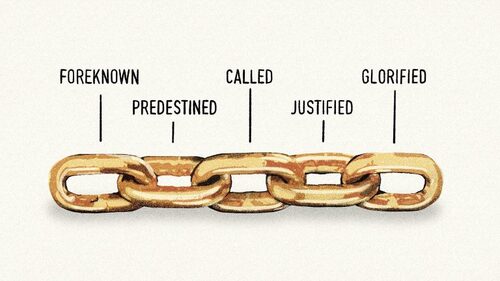
Five main doctrines, mentioned in Romans 8
Introduction
This study on redemption has an Evangelical approach, not a 5-point Calvinistic approach, using the 5-letter acronym TULIP.

If you have time to preview an interesting video on this topic, watch the video by Mike Winger, using this link; watch from the beginning to 15:50 minutes.
Verses quoted there:
Mark 13:20 ESV "And if the Lord had not cut short the days, no human being would be saved. But for the sake of the elect, whom he chose, he shortened the days."
Romans 8:33 ESV "Who shall bring any charge against God’s elect? It is God who justifies."
Ephesians 1:4 ESV "...even as he chose us in him before the foundation of the world, that we should be holy and blameless before him. In love ..."
Matthew 12:14 ESV "For many are called, but few are chosen.”
Acts 13:48 ESV "And when the Gentiles heard this, they began rejoicing and glorifying the word of the Lord, and as many as were appointed to eternal life believed."
It seems that there are verses that point to collective election.
Others to individuals that are chosen/elected by God. These verses don't say that free will is excluded.
In the Calvinistic doctrine the free will is taken away through Unconditional Election by God. I don't support that. God never takes free will away. Election is not unconditional, but related to foreknowledge.
2 Timothy 1:9 says "who saved us and called us to a holy calling, not because of our works but because of his own purpose and grace, which he gave us in Christ Jesus before the ages began".
In the Calvinistic doctrine the free will is taken away through Unconditional Election by God. I don't support that. God never takes free will away. Election is not unconditional, but related to foreknowledge.
2 Timothy 1:9 says "who saved us and called us to a holy calling, not because of our works but because of his own purpose and grace, which he gave us in Christ Jesus before the ages began".
Isaiah 42:1a says "Behold my servant (Jesus), whom I uphold, my chosen, in whom my soul delights ".
How are predestination and election connected with foreknowledge? Read this article, called chosen beforehand.
1 Peter 1:2 says "elect according to the foreknowledge of God the Father, in the sanctification of the Spirit, for obedience to Jesus Christ and for sprinkling with his blood: May grace and peace be multiplied to you."
Romans 8:29 says "For those whom he foreknew he also predestined to be conformed to the image of his Son, in order that he might be the firstborn among many brothers".
In Romans 8:29–30, the apostle Paul presents a concise yet breath taking formulation of God’s redemptive work from eternity to eternity:
For those whom he foreknew he also predestined to be conformed to the image of his Son, in order that he might be the firstborn among many brothers. And those whom he predestined he also called, and those whom he called he also justified, and those whom he justified he also glorified.
(ESV).
This passage introduces readers to five essential doctrines: (1) foreknowledge, (2) predestination, (3) calling, (4) justification, and (5) glorification. These doctrines are intricately linked, forming an unbreakable bond often called the “golden chain of redemption.” In this passage sanctification isn't mentioned. It is isn't an essential doctrine according to Romans 8. Sanctification is a process that continuously takes place during the lifetime of the believer on earth, from conversion till the rapture.
1
The chain begins with God’s foreknowledge. This doctrine is probably the most misunderstood, although the same could be said about predestination. The word foreknowledge is composed of two separate words: fore, meaning “beforehand,” and knowledge. So, to foreknow is “to know beforehand.” This does not mean that God foreknew or foresaw our faith and then chose us to be “predestined to be conformed to the image of his Son.” To the contrary, it means that, before the foundation of the world, God set His seal of affection upon those He purposed to elect (cf. Ephesians 1:4–5).
2
The second link in the golden chain of redemption is predestination, which is also composed of two word parts: pre-, meaning “beforehand,” and destination. Thus to be predestined is “to be destined beforehand.” This destiny is God's desire for everybody, not just for the so-called elect (Calvinism). The difference between foreknowledge and predestination is that the former does not tell us what God has destined (or planned) for the elect. And all humanity is elect. This is where predestination comes in. Having set His seal of affection upon us, God then “predestined [us] to be conformed to the image of his Son.” Not to the image of God, what was only said about Adam. Our destiny, therefore, is to bear the image of Christ (Ephesians 2:10). To this end, God calls, justifies, and glorifies us.
3
The third link in the golden chain of salvation is calling. In theology, there are two different kinds of calling: external and internal. The first call is external, general, and indiscriminate. This call, also known as the gospel call, is exemplified in Jesus’ invitation, “Come to me, all who labor and are heavy laden, and I will give you rest” (Matthew 11:28, ESV; cf. John 3:16; 7:37). This kind of call can be resisted (Matthew 23:37; Acts 7:51).
The second call is internal, specific, and effectual. Thus, it is more than an external invitation to trust in Christ for salvation. Through the agency of the Holy Spirit, God prepares the hearts of His elect to hear, receive, and respond positively to the gospel message. This call is effectual (or effective) because it accomplishes God’s intended purpose of drawing the elect to Himself and giving them new life (John 6:36–37; 10:14–18, 11:43). It is the effectual call that is meant in Romans 8:30.
The second call is internal, specific, and effectual. Thus, it is more than an external invitation to trust in Christ for salvation. Through the agency of the Holy Spirit, God prepares the hearts of His elect to hear, receive, and respond positively to the gospel message. This call is effectual (or effective) because it accomplishes God’s intended purpose of drawing the elect to Himself and giving them new life (John 6:36–37; 10:14–18, 11:43). It is the effectual call that is meant in Romans 8:30.
4
The fourth link in the golden chain of salvation is justification. Simply put, justification is the act of declaring or making righteous in the sight of God (Romans 5:1). Believers are declared righteous “not because of works done by us in righteousness” (Titus 3:5, ESV), but solely because of the imputed righteousness of Christ, received by faith alone.
Let us not suppose, however, that we produce the faith required for justification: “For by grace you have been saved through faith. And this is not your own doing; it is the gift of God, not a result of works, so that no one may boast” (Ephesians 2:8–9, ESV, emphasis added). In other words, saving faith is a sovereign and gracious gift of God.
Let us not suppose, however, that we produce the faith required for justification: “For by grace you have been saved through faith. And this is not your own doing; it is the gift of God, not a result of works, so that no one may boast” (Ephesians 2:8–9, ESV, emphasis added). In other words, saving faith is a sovereign and gracious gift of God.
5
The fifth and final link in the golden chain of salvation is glorification. In glorification, God will remove us from the presence of sin and place us into an eternal state of glory (2 Corinthians 4:17). On that glorious day, the light of God will shine upon us, and we will be free from sin, darkness, imperfection, and error. We will know Him fully, even as we are fully known by Him (1 Corinthians 13:12).
In Romans 8:30, Paul speaks of glorification in the past tense. This is because of his assurance that “he who began a good work in [us] will bring it to completion at the day of Jesus Christ” (Philippians 1:6, ESV).
In Romans 8:30, Paul speaks of glorification in the past tense. This is because of his assurance that “he who began a good work in [us] will bring it to completion at the day of Jesus Christ” (Philippians 1:6, ESV).
Conclusion
The golden chain of redemption reminds us that salvation is entirely an act of God (Jonah 2:9). It is God who foreknows, predestines, calls, justifies, and glorifies. The appropriate response is to “proclaim the excellencies of him who called you out of darkness into his marvelous light” (1 Peter 2:9, ESV).